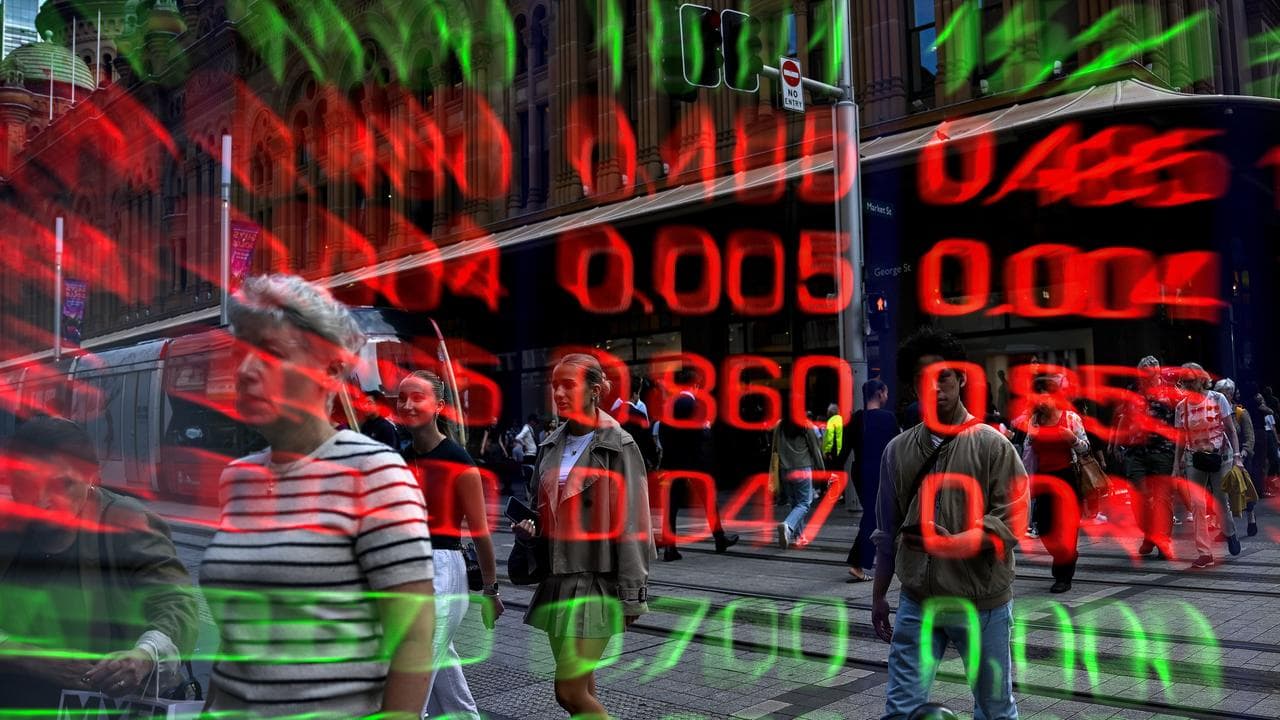
Australian sharemarket futures signalled a soft open on Tuesday, with contracts at 4.53am AEDT pointing to a fall of 39 points, or 0.4%, at the opening bell after a weak session on Wall Street.
The ASX had already eased 0.4% on Monday, and the Australian dollar was lower at US67.42¢, reflecting risk-off trading that hit global tech and AI-related stocks.
US markets led the downward move: the S&P 500 fell 1.2%, the Nasdaq composite dropped 1.7%, and the Dow Jones lost 395 points, or about 0.8%, in mid-session trade as investors reacted to turmoil at Nvidia.
Nvidia was the single largest drag on Wall Street, falling 2.3% after last week’s resignation of CEO Jensen Huang. The company’s chips power much of the AI industry and its cash has fuelled growth across the sector, leaving investors concerned about leadership uncertainty and industry direction.
“The market was already worried about this risk before what happened at Nvidia,” Zhiwei Zhang, president and chief economist at Pinpoint Asset Management, said. “Now the risk has become even more serious.”
Other chip and AI-linked companies also sold off. Broadcom slid 3.1%, Advanced Micro Devices lost 4.6%, CoreWeave fell 5.2%, and GE Vernova dropped 3.2% as earlier hopes that rivals could pick up market share faded.
All eyes are on Nvidia’s quarterly report, due on Tuesday after the US market close, when interim CEO Colette Kress will brief investors. The company has a recent record of beating expectations and delivering strong forward guidance, a pattern markets will be watching given the leadership change.
Outside semiconductors, L3Harris Technologies fell 2.6% after US officials suggested the contractor may be involved in a Federal Aviation Administration ground stop; the company said it is supporting the FAA’s investigation. Summit Therapeutics plunged 14.6% after the US Food and Drug Administration indicated it could not approve its lung cancer therapy application. Tyson Foods helped limit losses for the broader market, jumping 6.4% after reporting stronger-than-expected profit but weaker revenue on lower beef sales.
Earnings season remains a bright spot for US corporate results: FactSet data show S&P 500 earnings per share for the summer were almost 32% higher than a year earlier, marking the third straight quarter of growth above 25% for the index.
In fixed income, the yield on the US 10-year Treasury eased to 5.14% from 5.15% late Friday, after a recent spike caused by hotter-than-expected inflation data. Higher yields have already pushed up borrowing costs and pressured the housing sector.
Oil prices fell, with Brent crude sliding 2.6% to $US93.35 a barrel, removing some inflationary pressure as markets reassess the impact of tensions in the Middle East. Asian markets were weak as well: South Korea’s Kospi dropped 3.6% and Japan’s Nikkei 225 fell 2.4%, in part on tech sector weakness and a report that Japan’s economy contracted in the latest quarter.