Singapore Airlines has revealed the seating and cabin layouts that form part of a S$2 billion (about $2.26 billion) refit covering first class, business, premium economy and economy across its A350 fleet and its upcoming Boeing 777-9 order.
The overhaul was first announced in 2024 and was expected to begin appearing on the carrier’s 41 A350-900 aircraft this year. The airline now says the first A350s will start to be refitted in Q1 2027, after delays caused by industry-wide supply chain problems and hold-ups in seat certification.
Company executives explained the certification picture is mixed: seats for the ordered 777-9s have been signed off, even though the 777-9 aircraft itself is still awaiting approval, while the new seats intended for the A350 remain in the certification process and are expected to be approved by 2027, the airline says.
Singapore Airlines intends the redesign to sharpen its appeal to high-paying travellers, a segment that has driven strong revenue growth. The carrier has also benefited from shifts in Europe-Asia travel since February, picking up traffic that has flowed away from Gulf rivals.
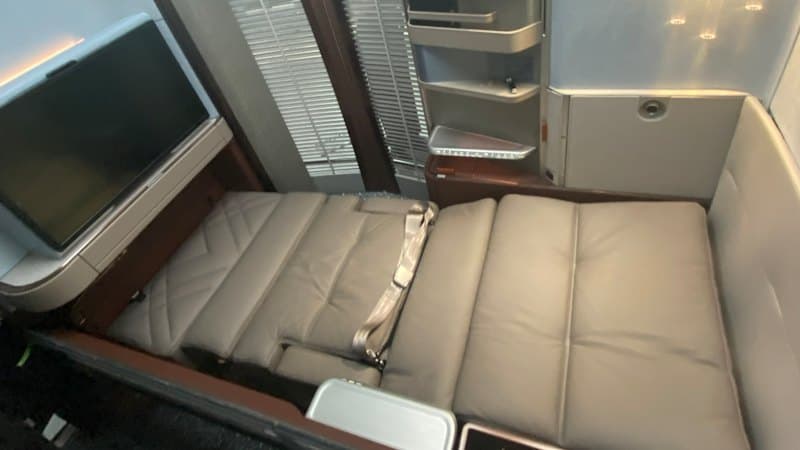
Designer PriestmanGoode’s first-class layout moves away from straight-line pods to curved aisles and slightly hexagonal cabins, a change intended to increase personal space. The seats will use Poltrona Frau leather, include full-flat beds measuring 80 inches long and 30 inches wide, and offer adjacent seats that can convert into a two-seat sofa for daytime lounging.
Business class will switch from a diagonal configuration to a straight fully flat bed developed by BMW Designworks and manufactured by Recaro, with a 79-inch bed and a meal tray that pulls down from under the seat back. Premium economy will gain adjustable foot and leg rests and extra storage, and economy seats will get a redesigned recline mechanism to improve knee and shin clearance.
The programme highlights how COVID-era disruption and a wave of fleet refresh decisions have put pressure on a small group of specialist seat manufacturers and on regulators who must certify new designs. Industry consultants note the seating sector is labour intensive and dominated by relatively few suppliers, which has magnified bottlenecks.
Seat certification itself is costly and time-consuming. Some factories, such as Recaro’s in Schwabisch Hall, Germany, run full crash-test facilities. A single business-class seat test can cost as much as €100,000 (about $162,000), and a new seat design may require up to 18 tests, with total certification expenses running into millions and extra checks for materials such as leather and flame retardant treatments.
With new aircraft deliveries delayed, airlines have turned to cabin refreshes to remain competitive: Qantas announced a 737 cabin update in 2025. That surge in demand for premium seating has strained both the manufacturers who build complicated cabin products and the regulators in the US and Europe that approve them.
The supply crunch has coincided with rising fares and stronger passenger numbers on some routes. Data from aviation analytics firm Cirium showed nine Singapore Airlines services from Australia to Europe carried 25% more passengers in the second quarter of 2026 than a year earlier, while average fares on those routes were up 109%.
Singapore Airlines says its 31 Boeing 777-9s are expected to arrive in the second half of 2027 and that it is working closely with seat and aircraft partners to meet milestones. The refit work, from design beginnings in 2018, through manufacturing in factories such as Collins Aerospace’s facility in North Carolina, to lengthy certification, illustrates why rolling out new premium cabins can take years rather than months.