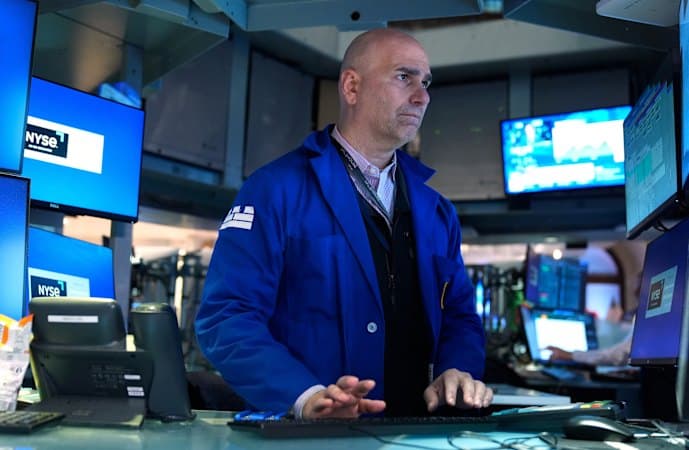
A heavy sell-off in AI-related technology stocks pushed the S&P 500 down 3.7% on Friday, tipping the benchmark into a correction after it fell more than 10% from its October 6 high. Australian sharemarket futures signalled a weaker start, pointing to a drop of about 49 points (0.6%) at the open, and the Australian dollar slipped to US66.28¢.
The Nasdaq composite, which carries a larger weighting in technology names, plunged 5.3% on the day and finished the week in negative territory for 2026. The S&P’s weekly retreat was the biggest in more than 18 months and capped a seven-session losing streak for the US market.
Chipmakers took the brunt of the selling. Nvidia closed about 14% lower, marking its ninth down day in 10 sessions, while Advanced Micro Devices slid 13.3%, Micron Technology dropped 13.9% and Broadcom lost 12.2%. The PHLX Semiconductor Index sank 10.7% on the rout.
Not all AI-linked firms were spared. Optical supplier Corning tumbled 10.9% and fuel cell provider Bloom Energy plunged 15.3%. The AI lab Anthropic, which debuted on the market on Thursday, fell 8.5% to US$88.91 on Friday but remained above its US$83 IPO price; its brief peak at US$115.10 the day prior meant the share price was down roughly 23% from that high.
Market participants cited concerns that sky-high valuations and large spending plans across AI-related firms may be hard to justify. Election results that favoured candidates seeking limits on data centre construction added to investor caution about the scale of future AI investment.
Michael Antonelli, a market strategist at Baird, said investors appear to be repricing the idea that AI can support unlimited spending and lift the stock market indefinitely, but he did not expect the broader bull market that began in October 2022 to have ended as a result.
The sell-off quickly spread beyond the United States. Japan’s Nikkei and South Korea’s Kospi each fell more than 5% overnight, and European bourses also moved sharply lower as traders sold technology and semiconductor exposure.
Major US indexes recorded sizable moves: the S&P 500 fell 265.44 points to finish at 6,910.39, the Dow dropped 949.73 points to 48,147.33, and the Nasdaq lost 1,261.47 points to close at 22,617.73. In bond markets, the yield on the 10-year US Treasury fell to 4.93% from 5.04% late on Thursday.
Commodities were mixed as geopolitical tensions continued to influence oil prices. Brent crude rose 0.6% to settle at US$92.57 a barrel amid reports of new missile and drone attacks by Houthi fighters and continued conflict in the region.
For Australian investors, the immediate implication is a risk-off mood at the open, with local technology and semiconductor-exposed companies likely to feel pressure from the global decline in AI-linked names. Consumer sentiment in the United States, by contrast, showed improvement: the University of Michigan’s index rose in November, helped by easing petrol prices and stronger expectations for business conditions following the midterms, although the level remains below where it was in February.
Markets will watch coming corporate earnings, data on investment in data centres, and any policy or regulatory moves related to AI infrastructure for signals about whether this sell-off is a short correction or the start of a longer period of volatility.